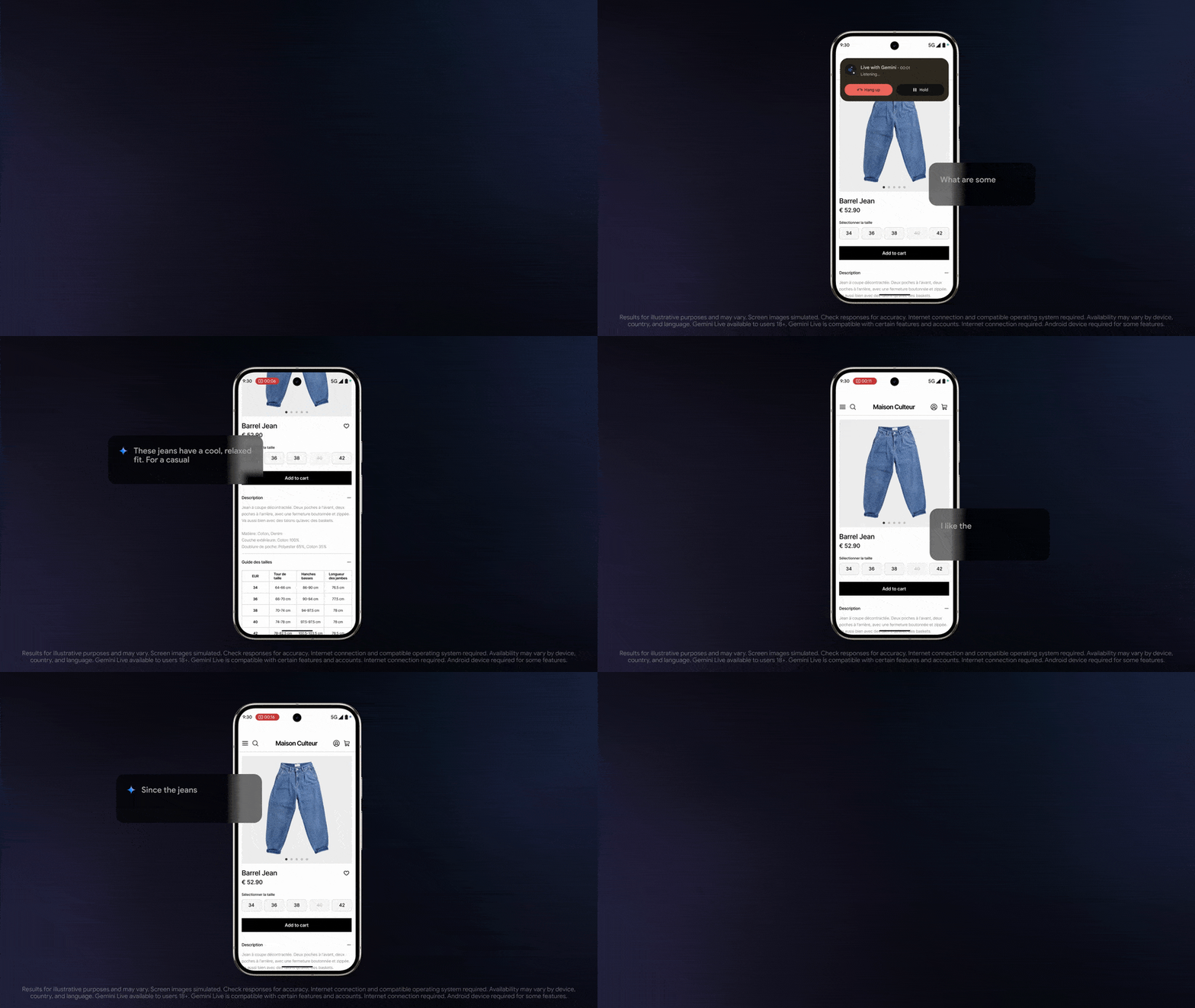
Currently @ Google DeepMind leading design for multimodal conversational and agentic experiences on Gemini Live, part of the Gemini App (1B+ users)
01Product + Model Design2026
Multimodal image generation
Turning a wild idea into a tangible proof of concept right at the moment you're experiencing it
I was skeptical at first. I wasn't sure that Gemini Live was the right place for Nano Banana. But then I built a prototype, and it clicked – not just for me, but also for my team. And it ended up clicking for users too, becoming the most used tool in Gemini Live.
Highlights
Prototyped the core interactions and flows in AI Studio on the actual APIs, which unlocked funding for the feature and drove requirements. Tested and refined interactions in Antigravity, steering Claude-generated code with hands-on edits.
Defined the eval rubric & set, analyzed losses, and adjusted the UI and conversation design accordingly, such as adjusting the image ratio and rewriting the system instructions governing the handoff and completion phrases.
Turning chaos into clarity and ideas into action — long after you finish talking
Spark leaned power-user. But it didn’t have to. Live could make Spark easier to use by integrating it directly into a conversation. Bringing this into Live meant solving multiple problems at once: when and how to implicitly trigger Spark, how to maintain trust when the task moves into the background, and when and how to resurface.
Highlights
Defined decision heuristics with UX and Product partners for when a request should route to Spark, an especially ambiguous space given overlap with other capabilities, and tested with side-by-side evals
Designed the visual and spoken affordances aimed to provide visibility of system status of background agentic tasks
Designed the foundational framework governing the lifecycle of a task, including if and how a background task re-enters the primary dialogue
Deciding if, when, and how Gemini should show and tell.
Visuals aren't always necessary. We shouldn't show for the sake of showing. To validate this hypothesis, I took a “fast and slow” approach – learning quickly through a focused set of deterministic outputs and developing a foundational framework, eval rubric, and training data to shape model behavior upstream.
Highlights
Shipped MVP with simple turn-based auto-dismiss to learn from real usage, while iterating toward smarter, criteria-based dismissal and flexible layouts.
Navigated pushback on my original thesis because it added rigor that read as unnecessary complexity. Held the line to avoid adding extraneous cognitive load and breaking the core premise of audio interfaces.
04Design Lead2025
Video and screen sharing
Seeing and understanding your physical or digital world as you move through it.
It wasn't clear how to productionize a research prototype. At I/O 2024, Project Astra introduced the future capabilities of a universal AI assistant capable of understanding the world around you. With limited foresight into how users would actually use this feature, I led the design for productionizing this prototype, ultimately winning “Best of MWC” and a “GLOMO” award and becoming a key driver of new users.
Highlights
Drove cross-PA alignment to improve the screen-share indicator and permissioning UI and flow.
Addressed the shortcomings of our previous eval approach – a random spread of prompts – by introducing a taxonomy that represented the actual range of use cases, which became the “gold standard” across the team.
Introducing a new, more natural way to communicate with AI through real-time audio dialogue
We wanted to let people “think out loud”, and trust Gemini could follow along. I was new to the team and had to quickly get my arms around work to-date, structure the thinking, identify the remaining work, and mobilize a group of 10 designers who hadn’t worked together, balancing oversight and empowerment to maintain momentum without losing cohesion.
Highlights
Created and managed the Gemini Live MVP design system in Figma, ensuring quality and cohesion across the E2E experience.
Pre-reviewed all UX changes from the design team, identified and resolved gaps, and worked with designers to clarify designs and rationale.
Taking Gemini out of the browser and putting it in your pocket
From pitch deck to the app store – taking an app from 0 to 1 (Billion) When Gemini first launched, it was capped by the browser. I was on a team of 5 designers to pitch execs on a different bet: a mobile app that would unlock new capabilities, increase adoption, and later became the fastest growing app in Google history, surpassing 1 billion users in 2 years.
Highlights
Pushed for onboarding that named the gaps between Assistant and Gemini directly. Ended up shipping a more optimistic version first, however users felt misled. I diagnosed it and shipped a fix to recover ratings and user sentiment.
Identified a fundamental conflict between 2 key user journeys (input vs browse) on the home page, and advocated for an opinionated design rather than trying to equally serve both goals, which would compromise coherence and clarity.
I've always been fascinated by the “and”; the space in-between. It first drew me to study human-computer interaction, then to investigate how people calibrate trust in AI-assisted decisions, and eventually to design at the intersection of the model and the interface, where I try to understand and shape emerging capabilities in ways that work for and with people, so that we don't outsource what makes us, at our core, human.
Outside of work, I am:
Plotting on my next travel or hiking adventure
Tinkering in the kitchen (was recently afflicted by the Covid-era bread obsession)
Sharpening my latte art skills
Finding the best slice in NYC (currently Chrissy's)
Wrangling a happy hour & trying to perfect the art of “splitting the G”